
TradeyAI Monthly Report · August 2026
August was about moving from "it runs" to "you can trust it."
Most of our engineering went into a new direction for TradeyAI. The first generation of agents let a large language model decide every entry and exit on its own — the same market could produce different calls. The new version runs on a rule-based strategy engine: once a strategy is written, every entry and exit follows the same rules, so its behavior is fully predictable and backtestable. The uncertainty of each decision is gone.
By the time you read this, it is already in closed beta — v2-beta.tradeyai.io, simulation only. Requests to join the first wave of testers are welcome.
1. Build your own agent by chatting
The new site has a single entry point: a chat box.
Describe the strategy you want in one sentence — "Build me an agent that buys SOL when RSI is oversold on the 15-minute chart." TradeyAI checks data coverage, pulls up a reference strategy, and lays out the entry/exit rules, risk settings, and parameters as a plan card for you to confirm or adjust before anything else happens.
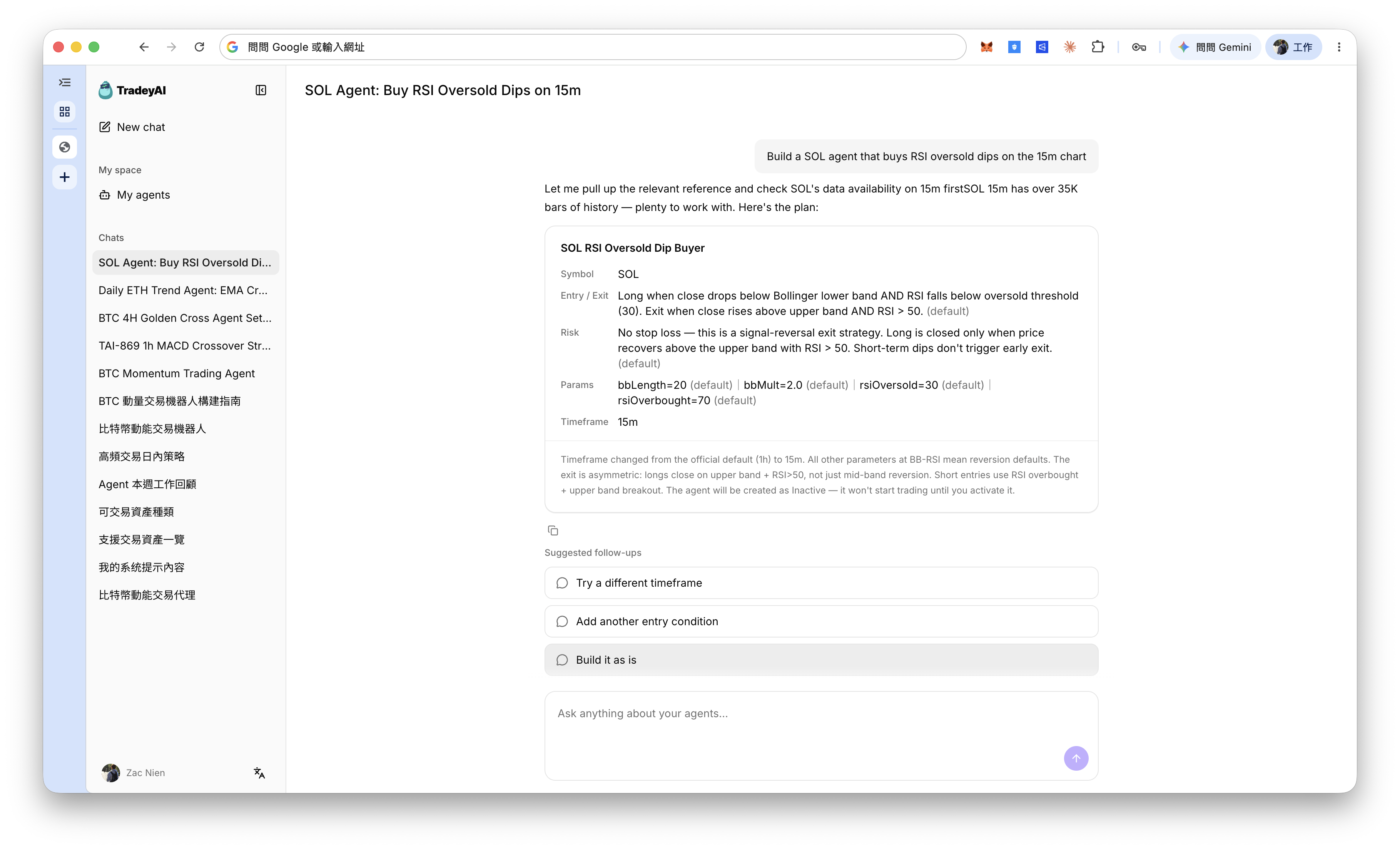
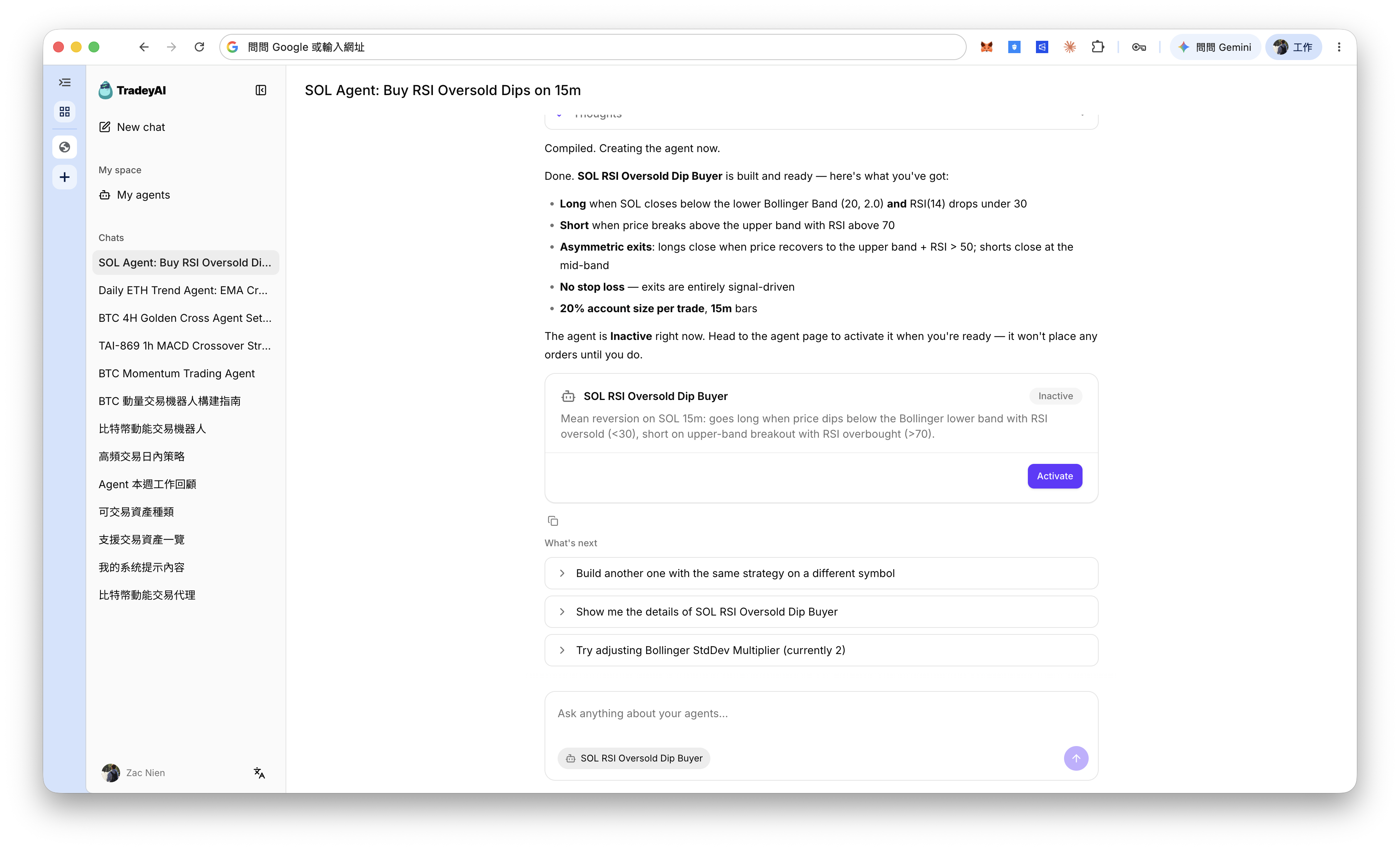
Once confirmed, the generated strategy is compiled and verified first — every parameter and indicator it uses is confirmed to be valid and executable before the agent is created.
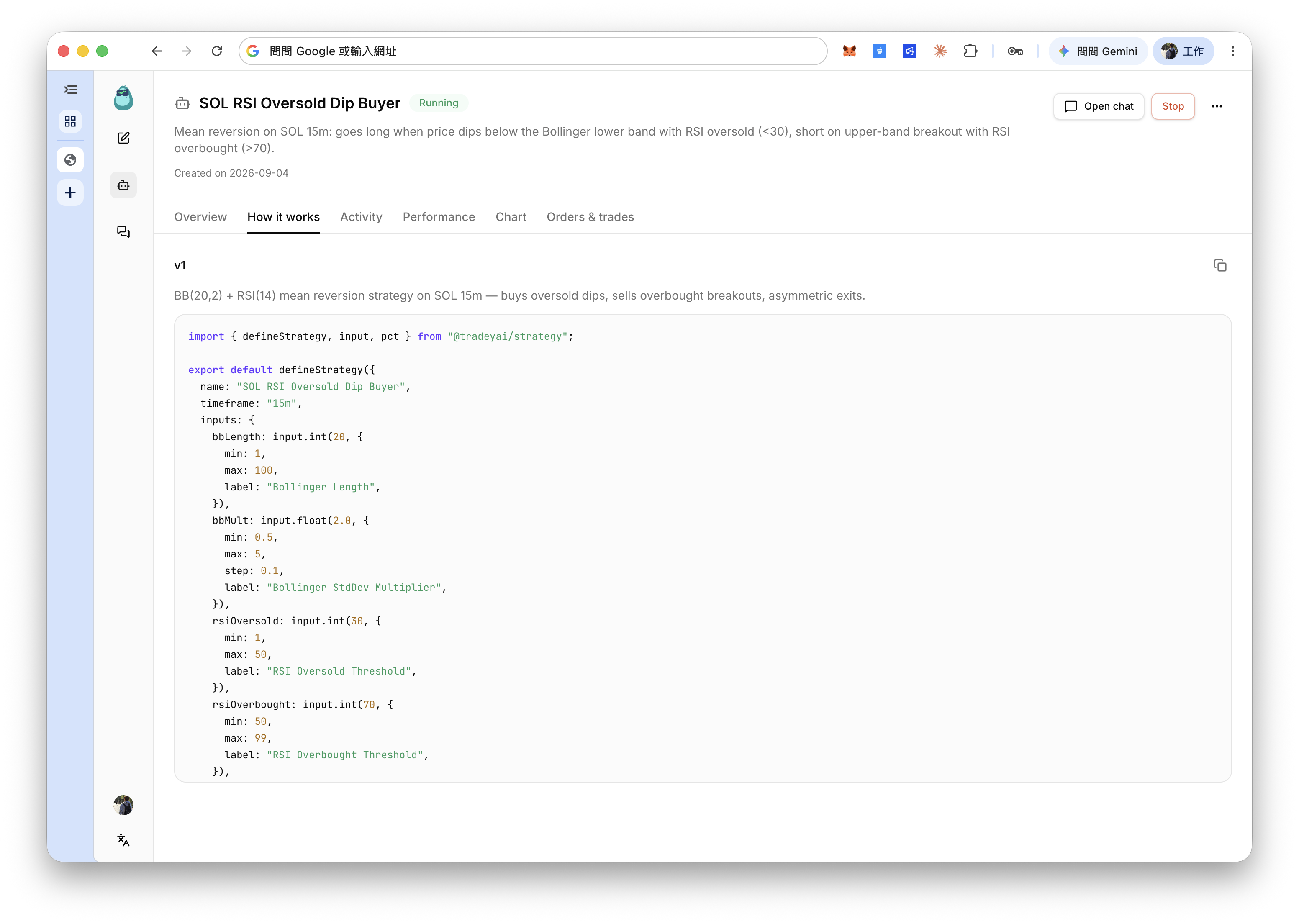
The strategy is not a black box: the source code sits right on the "How it works" tab, with the meaning and adjustable range of every parameter laid out.
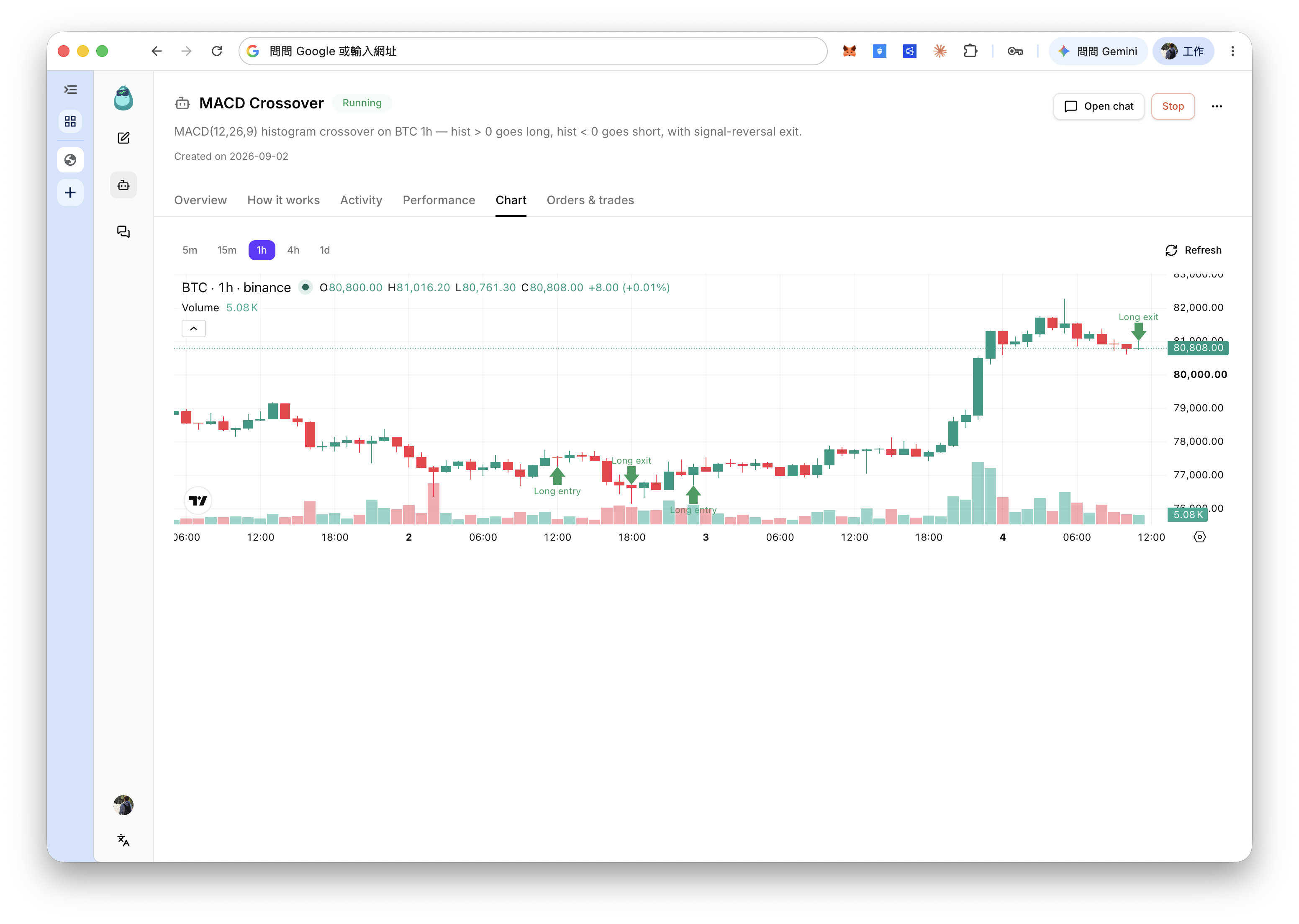
Once the agent runs, what happens on every candle is drawn on the chart: entries and exits are marked on the K-line, alongside each round's decisions and fills.
2. Simulated trading became real
The new site is a simulation-only environment, so we started by making the simulation itself real. A simulated account used to be a piece of paper: no liquidation, no funding fees, fill prices decided by the system. From this month, simulated accounts settle by the same rules as a real exchange:
- Liquidation is real: cross the liquidation price and the position is gone, just like a real account
- Funding fees apply: charged or paid by position side at every settlement point — holding is no longer free
- Fills judged by the candle's range: a limit order fills only when its price falls inside that candle's high–low range, not by a single close price
- Live prices: a simulated account's mark price and liquidation checks now use the exchange's live quotes
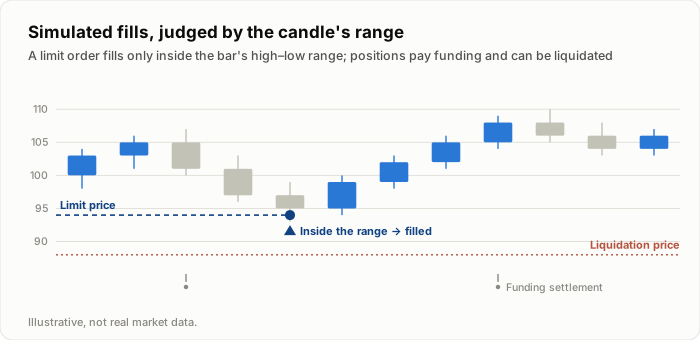
The performance you see in a simulated account is the performance that same strategy would earn in a real one.
3. Positions are never left naked
The worst thing in automated trading is opening a position while its protective order fails to go on. In July we found and fixed a whole batch of these defects. In August we walked every fixed path again with real money, and four guarantees passed for the first time:
- When a position opens, its protective order always goes on with it; if it can't, it retries immediately.
- After scaling down, the protective order's size follows — never over- or under-closing.
- The system continuously audits for "any position without protection," and remediates and alerts on the spot.
- When several agents share one trading account, they never cancel each other's protective orders.
The evidence: across 90 straight hours and 102 live-capital rounds, every position had protection following it the whole way. The only two protection gaps in that window were closed automatically in 2 seconds and 3 minutes; before July, the same kind of event took 23 minutes — with no alert.
Two smaller improvements: expired exchange credentials now show up directly in the agent list instead of stalling silently, and agents that hit an exchange rate limit at the same time now stagger their retries.
4. Chat that actually knows your account
Trust comes from being explainable. In July we made agents say clearly "why I did this"; in August we made every number they cite traceable. When an agent answers about funds, protective orders, or past decisions, every figure comes from the actual account or exchange data — never from memory or a hallucination. Three real exchanges:
Asking about funds
You: How much do I have left to open a position?
Agent: $412 available. Operating funds $500, margin used $88. There's also $300 in reserved funds you haven't allocated to me — I won't touch it. Total account equity $812, from a snapshot 3 minutes old.
Asking whether a protective order is actually on
You: Is my ETH stop-loss really placed?
Agent: Yes. Your stop is set at $2,850, and the exchange-confirmed trigger order is on the book, synced 2 minutes ago.
Asking why it didn't enter last round
You: Why didn't you enter last round?
Agent: At the 08-14 03:00 round, BTC's 4-hour RSI was 58, short of your 65 threshold. Funding was +0.012%, crowded on the long side, so I chose to wait.
For figures it can't find, the agent simply says "I can't find it" — it won't fill the gap with a formula or a stale value.
5. What users are trading
In July we lifted the ceiling on what you can trade. In August, here's how users actually used it:
| Asset class | Share of users who traded it | Share of positions opened |
|---|---|---|
| Crypto | 95% | 88% |
| US stocks | 32% | 11% |
| Metals / Energy | 18% | 1% |
- US stocks' share of positions: July 7% → August 11%.
- Nearly half of users (45%) run agents across two or more asset classes at once.
- Most popular US stocks: NVDA, SPCX, TSLA, GOOGL, MU, PLTR.
- Users traded 42 distinct symbols in August.
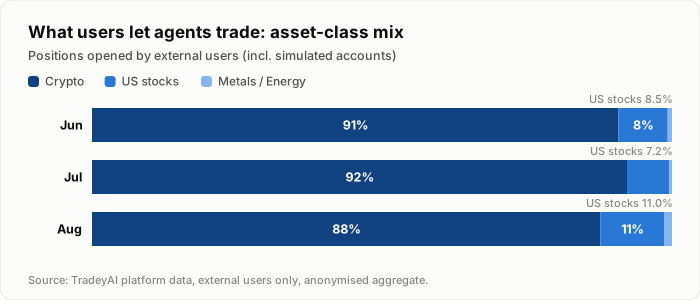
Cross-asset is no longer a novelty — it's becoming the norm.
6. Steadier, and quicker to fix
- Market-data services moved to their own host, isolated from trading services
- Daily backups extended to the beta environment, with a real restore drill completed
- Deploy time cut from an hour to about 10 minutes, so fixes ship faster
What's next
- The new site keeps evolving — refining the chat-to-agent experience from beta feedback, and gradually bringing the main site's capabilities into it.
- From simulation to real — strategies validated on the new site will be able to connect to a real trading account in one click.