
TradeyAI Monthly Report · September 2026
September was about opening the doors and closing the loop.
August's report ended with two promises: the new site keeps evolving, and strategies validated in simulation can connect to a real account. September delivered both. The new site entered closed beta on September 2, the engine made over ninety thousand bar decisions in four weeks, and the full path — build an agent in one sentence, backtest it, revise it, activate it, watch it run, fix it when it stalls — is connected. Real-account binding and execution also went end-to-end with real money at the end of the month, and opened to beta users on October 1.
By the time you read this, tradeyai.io points to the new site; the original site lives on at v1.tradeyai.io.
1. The new site opens: seven languages, one chat box
On September 2 the new site opened to whitelisted users for closed beta. The interface shipped in seven languages at once — Traditional Chinese, Simplified Chinese, English, Korean, Vietnamese, Spanish and Portuguese — picked automatically from the browser on first visit. Official strategy templates and the Copilot's replies follow the user's language too. In the first week, external users built their own agents in Portuguese, Spanish and English.
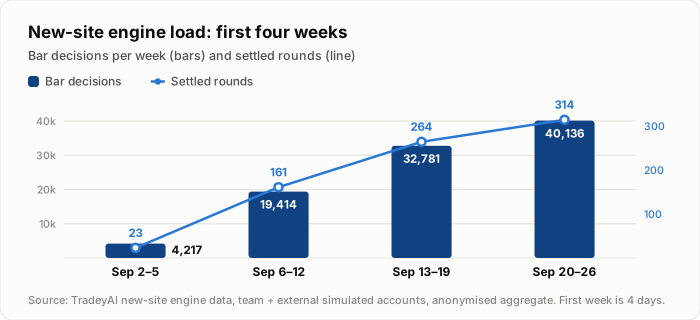
Over the first four weeks, weekly bar decisions grew from four thousand to forty thousand and settled rounds from 23 to 314. By month end, 120 agents were running at once across 43 symbol-and-timeframe combinations.
2. From one sentence to live: backtest, version, activate
In August the new site could only "take one sentence and build one agent." September filled in the steps that belong in between:
- Backtesting (September 17): say "backtest this" in the chat and the Copilot runs it, returns a card with total return and the equity curve, then suggests the next optimisation based on the result. The result page lists win rate, profit factor and max drawdown, and the candlestick chart marks every entry and exit. From October 1 the agent page also has a Backtests tab where you set the window, fees, minimum order size and leverage yourself.
- Updating a strategy by chat (September 15): "move position size from 3% to 7%", "add a fixed 2.5% stop-loss" — the Copilot reads the current strategy first, then changes it, and lays out what changed and how each parameter moved as a confirmation card. If the agent is running, it guides you to stop it first.
- Strategy versions (September 23): every backtest or applied change is pinned as a version. Activation starts by choosing a version, so how each version performed is on record.
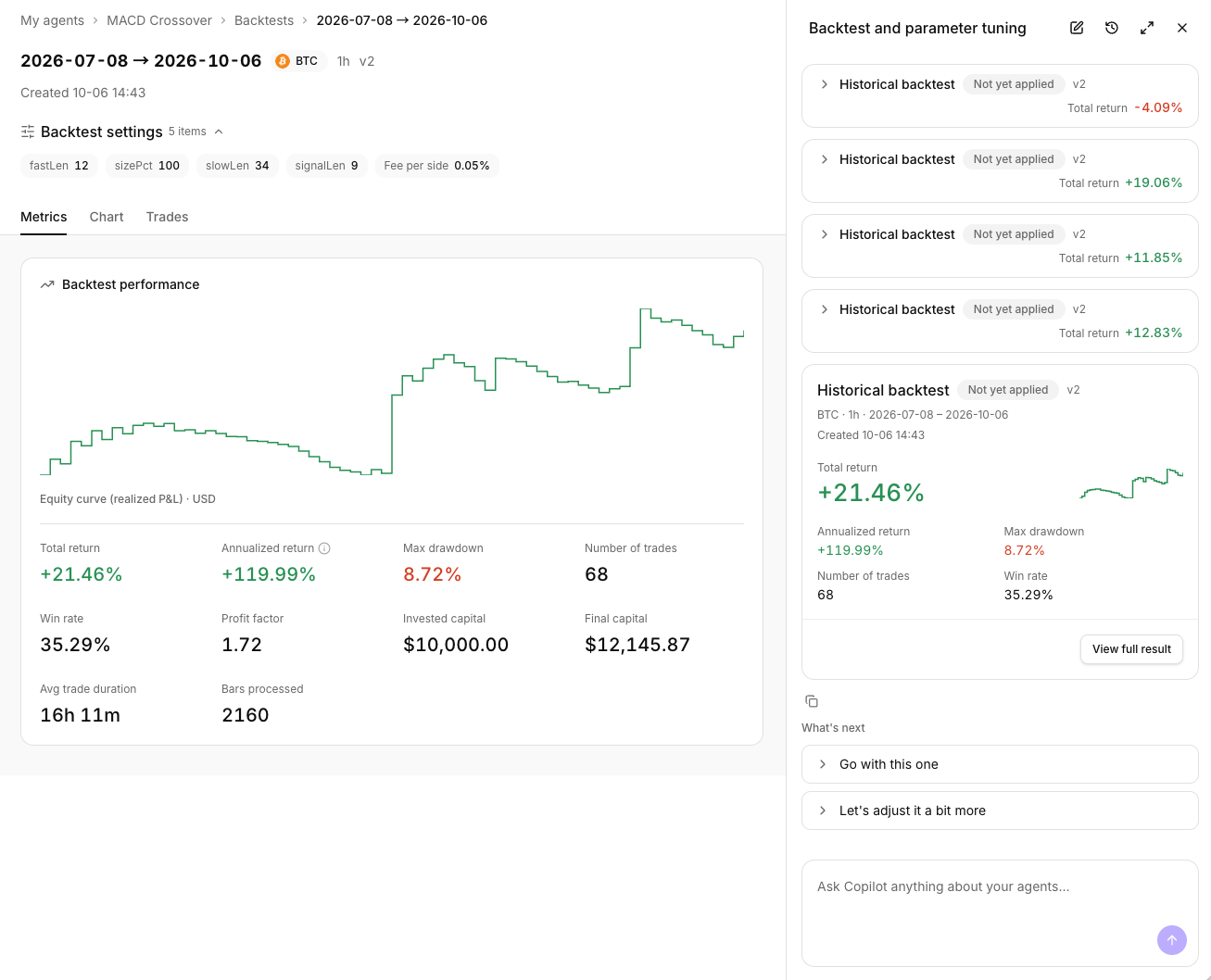
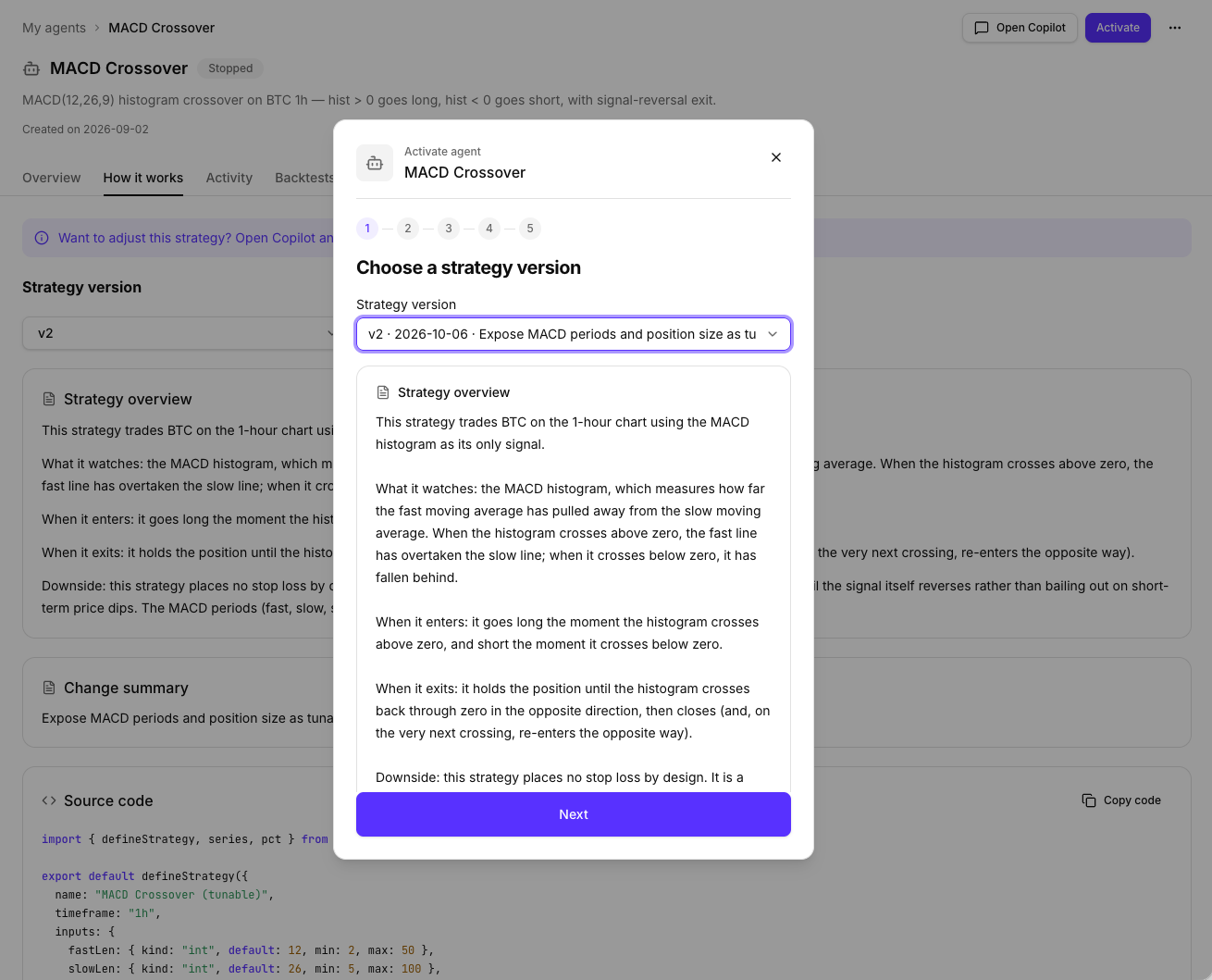
Once versions shipped, user behaviour changed visibly: from "build a new one" to "improve the old one." In the week it launched, new agents created halved, backtests tripled, and users stopping old agents on purpose doubled — people started raising one agent instead of spawning new ones.
3. Every decision can be looked at afterwards
The point of a rule-based strategy is that every decision has a reason. September put those reasons on the page:
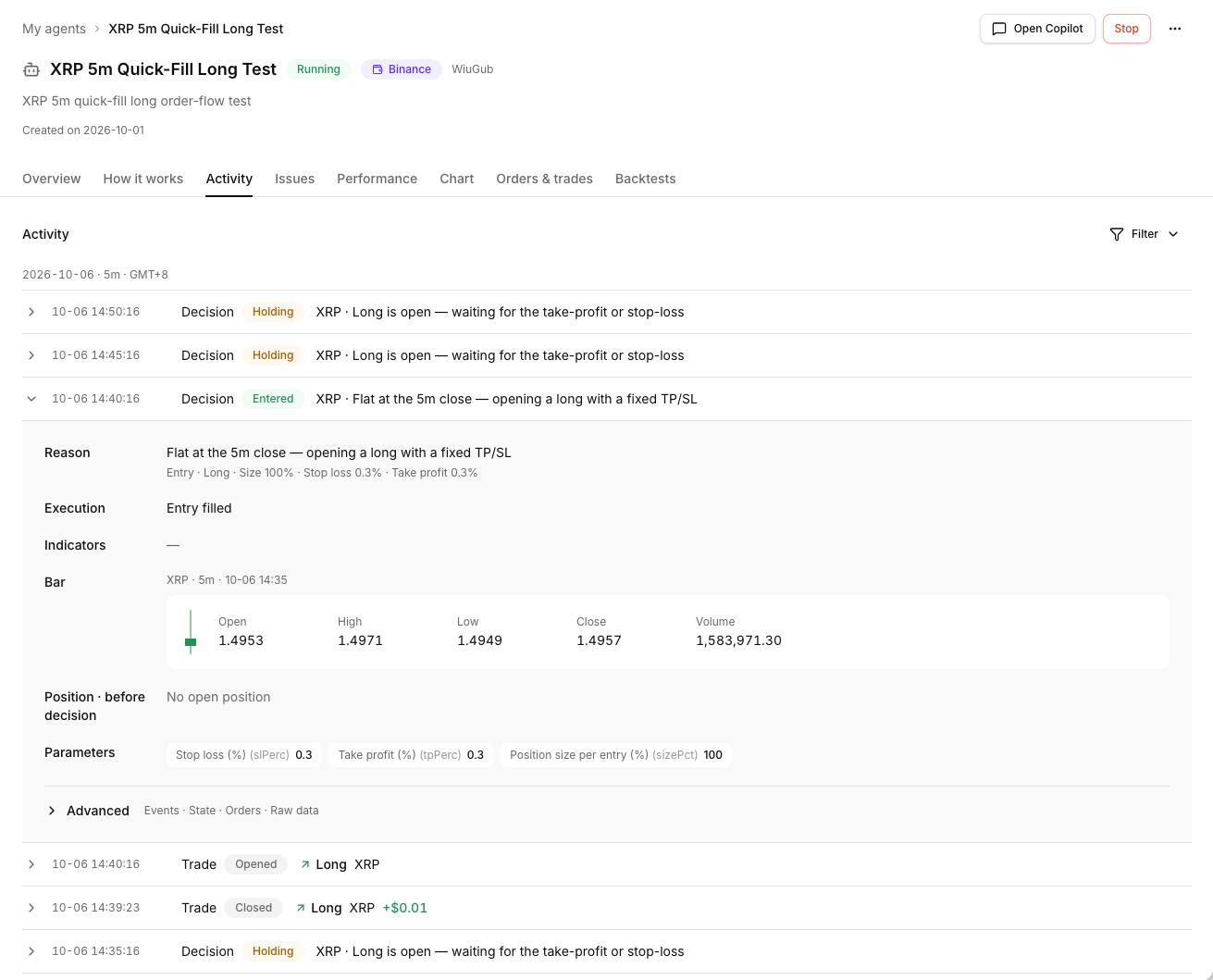
- Decision snapshots: every bar's decision keeps the candle, indicator values, position, parameters, reason and execution result as they were at that moment. Even "no entry" has to say which condition failed — "price has not broken the Bollinger band, or RSI is below the threshold" — rather than a vague "waiting."
- Activity expand card: open any decision and see all seven panels at once; "holding" and "flat, no entry" are labelled separately, and long runs of no-entry rows can be collapsed.
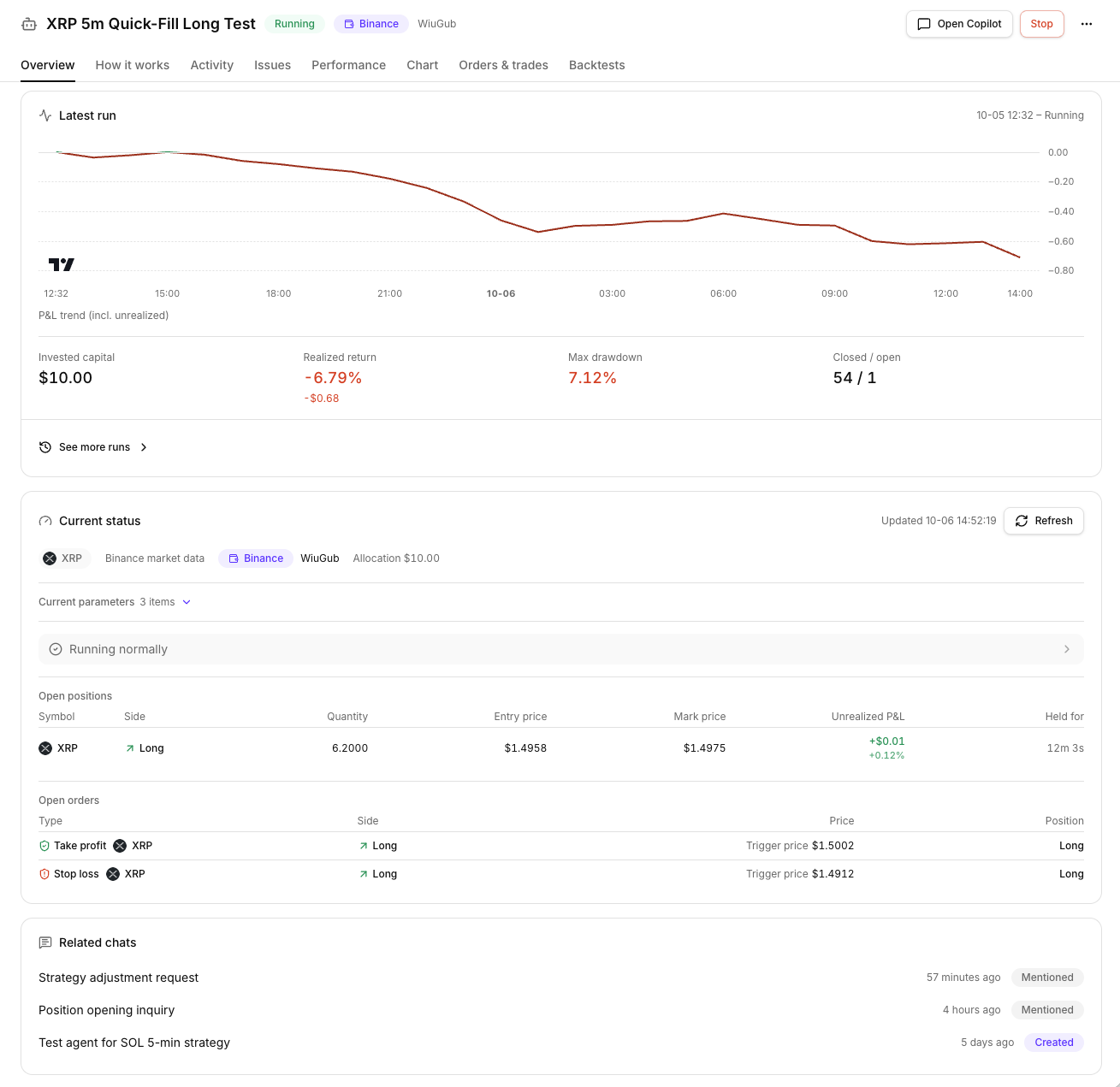
- Overview page (September 23): the current-state card refreshes every 30 seconds — execution settings, live parameters, issues, positions and open orders in one place. Orders and positions come from the same source, so the numbers no longer contradict each other after a close.
- Agent list: every agent is labelled Running, Degraded or Stopped, so it's obvious at a glance which agent needs attention.
4. When an agent stalls, it's visible — and fixable
In the second week of beta we saw a pattern: some agents never placed an order, and their owners didn't know why. The usual causes were a strategy with no declared stop-loss being rejected by the engine, an allocation below the exchange's minimum order size, or a bug in the strategy code — over a thousand rejections of this kind in a single week.
From September 16, the engine keeps an issue list for every running agent:
- The agent page gained an Issues tab. Each issue explains the cause in plain words, how long it has persisted, and the matching action: fix with Copilot, adjust the allocation, or stop.
- Press Fix with Copilot and the Copilot reads the issue code, edits the strategy code or parameters directly, and returns to the same conversation for confirmation.
- When account-level issues (rejections, insufficient funds) cross a threshold, the agent's status becomes Degraded instead of Running.
- Activation now estimates the first order's size up front; if it falls below the minimum, it suggests an allocation — without blocking activation, but without letting anyone walk into the trap.
The effect is measurable: the same class of rejection fell from 360 a day to 72. One user whose six early agents were all rejected built their first agent that actually filled in week three, then adjusted its position size by chat, then started sending feature requests.
5. The road to a real account
August's promise: a strategy validated on the new site can connect to a real trading account. September delivered:
- Bind a Binance account: the binding dialog lists the egress IPs to add to the API key's allowlist; once the key is pasted, the system checks its permissions first — trading only, no withdrawals. The risk disclosure must be read before binding.
- The allocation is the ceiling: real-account activations always use isolated margin, and the agent's orders are capped by the allocation. It never touches other funds in the account.
- Quotas: each user has a cap on concurrently running real-account agents, and the system has an overall cap, so exchange rate limits can't spill over onto everyone.
- Verified end-to-end with real money: the team walked the full loop on a real account — bind, activate, enter, stop-loss triggered, stop, unbind. Stop-loss and take-profit fills are now recorded as SL/TP rather than mislabelled "manual exit."
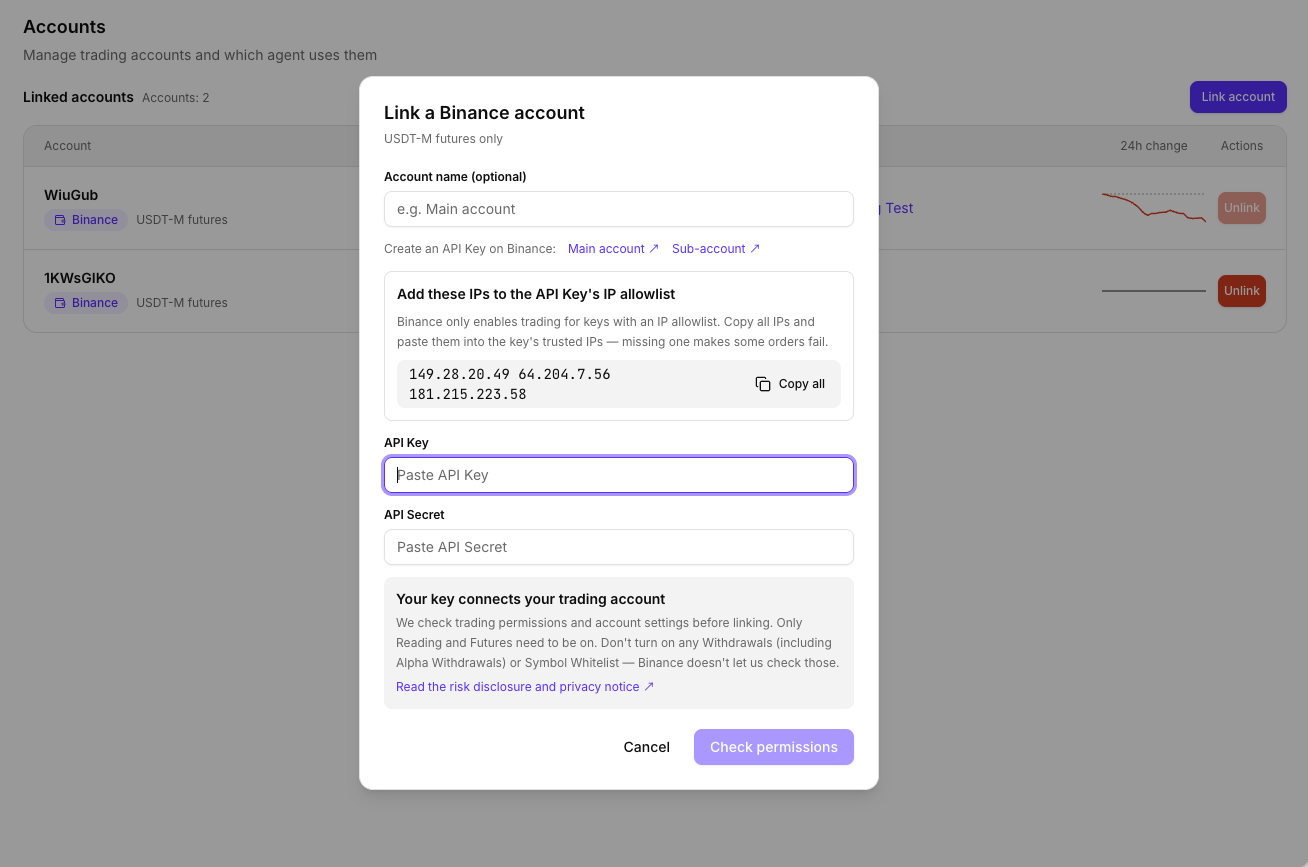
Throughout September, real-account binding was open to the team only. From October 1, beta users can bind their own Binance account.
6. Steadier
- First matching-layer incident, caught by a watchdog that went live the same day: on September 21 the simulated matching engine lost its database connection for 34 minutes. Decisions on 129 bars were recorded as "data read failed"; there were no wrong orders and no wrong closes, and the service recovered on its own. The health watchdog had gone live that very day, so the alert arrived immediately. Retry and graceful degradation on read failures were added afterwards.
- Deploys are now one pinned command: a host-side deployer pins a version and rolls it out, confirming the new version is ready before switching traffic. A rollout no longer cuts off conversations in progress, and rolling back is one command.
- Centralised backend logs: every service's logs land in one search interface. Finding out why a decision was rejected went from digging through hosts to a single query.
- Fixed Binance egress: after moving the original site to new hosts, all Binance traffic exits through a fixed address, so users' API whitelists didn't have to change. Binance-side errors dropped to zero in the first week after the move.
- Feedback loop: eight test reports and in-app feedback in September became 73 tickets, 46 of them fixed and live.
What's next
- Real accounts for beta users — Binance binding opened on October 1; leverage options and scaling in and out of positions come next.
- Notifications — when an agent enters, exits or runs into a problem, it reaches you directly, without checking the site.
- Wider whitelist — admitting the waiting list in batches so those waiting can get in.